top of page

Following on from my last blog post where I hacked the Lyra into a shirt and added a tie detail to the sleeves, I thought I would show you three different ways to style it! I really enjoyed the process of trying out different outfit combinations and it was a very inspiring process! These style would work with any shirt so if you're looking for inspiration for styling a shirt, take a look.


Firstly, the original way I styled the shirt, buttoned up with a pair of jeans. These jeans were a recent charity shop find and an absolute bargain which I was really pleased with! This was the first outfit I thought of when I made this shirt and it's the simplest. However when I tried other outfit combinations I think I preferred those.


Secondly I tried the shirt on with my Tilly and the Buttons Erin dungarees and I think this was my favourite. I really liked this style and it's super comfy but also looks put together. I can't wait to wear this outfit in the autumn, and it feels great knowing the whole outfit is handmade!


Thirdly, I paired the shirt with a Tabitha T-shirt (from the Make it Simple book) and some ready-to-wear jeans. I wore the shirt open this time and this is a much more casual style and quite different to my usual look but I really like it. It was really fun to try something different and step out of my comfort zone! But this look was also really simple to pull together and very easy to re-create.


For this project I used a new-to-me approach and decided to try and re-create a ready-to-wear top. I decided I wanted to try some sort of hack of the Tilly and the Buttons Lyra because I liked the collar and button front opening, and I knew I wanted to use the navy gingham from Tabitha’s House so I started looking at gingham shirt inspiration on Pinterest. Below is the shirt I decided to try and recreate. One of my favourite details on this shirt are the ties on the sleeves because I think this is quite an unusual detail, but it looks really pretty.
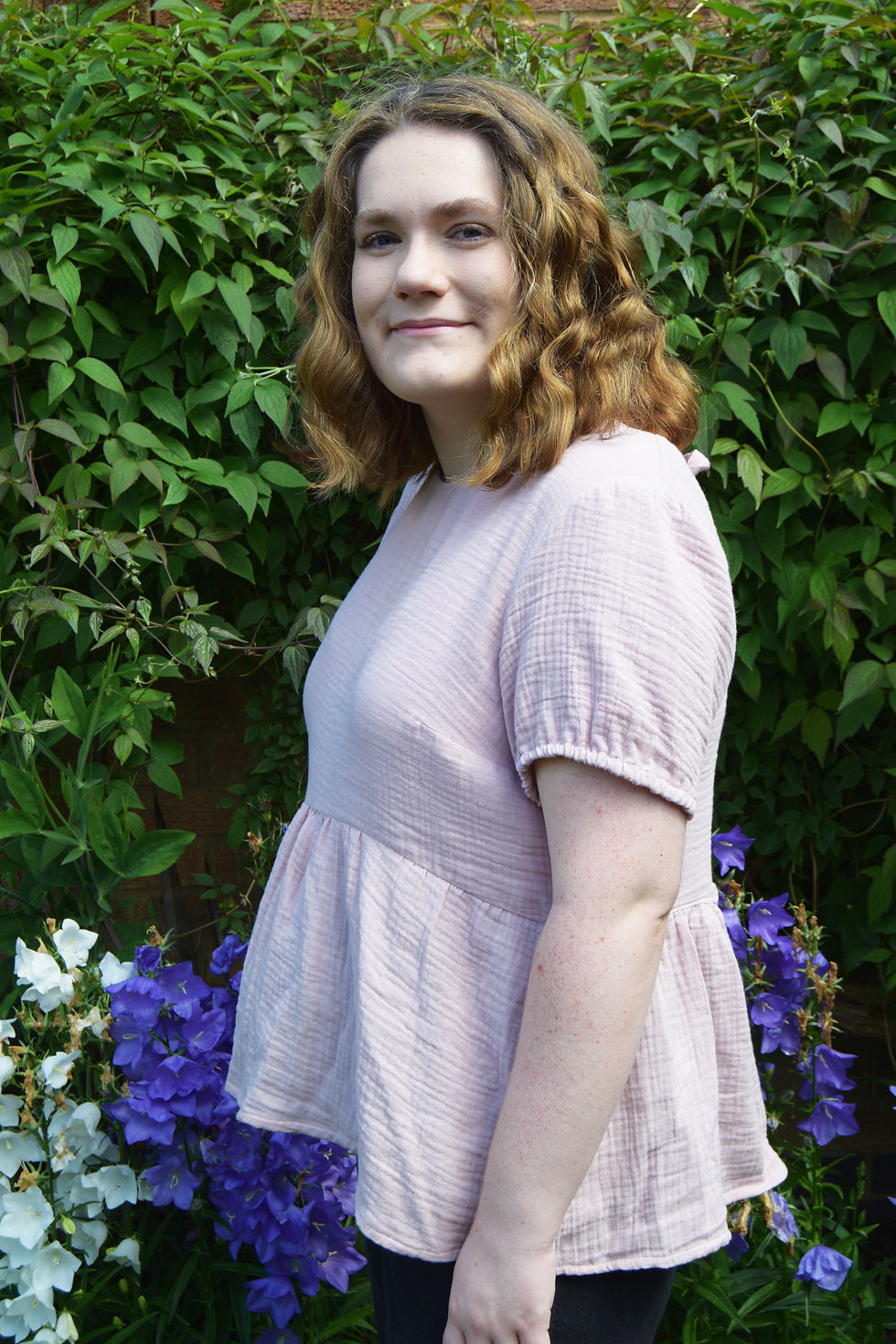

Image credit: ASOS

Here are some photos of my finished Lyra shirt! I’m really pleased with how it’s turned out because I think it looks pretty similar to the inspiration image and I can imagine getting lots of use out of it. I also like how I could style it in different ways such as open with a t-shirt underneath and with different trousers or skirts. I think it would also look great under dungarees!


If you want to recreate this style here are the adjustments you need to make to the pattern pieces.

1) Firstly, lengthen the front and back bodice pieces to your desired length – I had previously made a Lyra so I put this on to see where the bodice came to on me and how much longer I needed it to be. I ended up adding about 15cm but I would advise measuring the original pattern pieces and checking how much you want to add to create the right length for you. Make sure to lengthen both the front and back by the same amount and I simply followed the angle of the side seam and centre front/back lines down further.

2) Secondly, lengthen the button placket, adding the same amount of length as you added to the bodice pieces.

3) Now you need to make a pattern piece for a channel for the sleeves. Decide how high up you want the channel to fall on your sleeve and measure the sleeve width at this point. Then draw a rectangle with this width and a depth of 2 cm plus 1cm seam allowance either side.

4) Then the last step of this stage is to create a pattern piece for the ties. Use your wrist circumference and the length you would need for whatever size bow you would like as a guide for how long this should be. For a 1cm wide tie, the width should be 4cm (2cm seam allowance and 2cm folded in half for the actual tie). And that’s it! Those are all the pattern adjustments you need to make!


Cutting out the Lyra

As for the construction, follow the original Lyra instructions but without adding the skirt and there are just a few extra steps to inserting the sleeves. Before attaching the sleeves to the bodice you need to attach the channels for the ties and sew two button holes at the centre of each sleeve pieces. Whilst the sleeves are flat, mark the two opening for the ties (about 1.5cm apart) in the centre of the sleeve, at whatever point you want the ties to fall at. Then sew two buttonholes at these points. Repeat for the second sleeve. Then sew the gathering stitches across the sleeve head and sew the underarm seam. Next sew the short ends of the channel together and fold in each long edge by 1cm to the wrong side.


Pin the channel to the sleeve at the height you want it to fall with wrong sides together, matching seams. Stitch about 2-3mm in from each folded edge of the channel to attach it to the sleeve. Then you can sew the sleeve onto the bodice.


Sewing on the channel

To make the ties, fold them in half right sides together and sew down the long edge with a 1cm seam allowance. Then trim the seam allowance by about 5mm and turn the ties the right way out. Now attach a safety pin to one end and feed the ties through the channels on the sleeves. To finish the ends of the ties, fold the raw edges to the inside and topstitch across. Hem the sleeves and the main body and you’re finished!


For my blog post for Tabitha’s house, I decided I wanted to make an indigo, but hacked to include some extra pretty details! I chose this lovely double gauze because it’s a really pretty colour, beautiful texture and I haven’t used double gauze before so I wanted an extra challenge. The true colour is difficult to capture but it’s a light pink/ lilac.


The extra details I wanted to add were a tie at the back and short, gathered sleeves. If you like these details and are interested in adding them to your next project, this blog post will walk you through the process step-by-step. I used the Tilly and the Buttons indigo as the base pattern because I really like the smock top shape but you could use this process for other patterns too. Just as a note I graded from a size 6 at the bust to a 5 at the waist.


Tie detail pattern adjustments:

Firstly, how I added the ties at the back. I was inspired to add ties from the Tilly and the Buttons Stevie and used this as a guide for converting the Indigo. Firstly, take your back piece and decide how far down you want it to split from the top. Then draw a horizontal line, squared across from the centre back and cut. Now remember, as this will become a seam, we need to add seam allowance to both sides, so you will need to re-draw the pieces with seam allowance added to those edges. Also add seam allowance to the centre back edge of the upper back piece, as we will apply facing here so will need seam allowance. On this same edge, add notches to help you position the ties, 1.5cm down from the neck and another, the width of the final ties. My ties were 2cm wide so the notches were positioned 1.5cm and 3.5cm down from the neck. Draw out the tie piece, to your preferred width and length with added seam allowance. As stated above I chose to make my ties 2 cm wide and so I doubled this (since it will be folded in half) and added 1.5cm seam allowance. So my final tie piece was 7cm wide and 28cm long.


The only other pattern piece you need to create is the facing. Decide how wide you want the facing to be and draw this onto the front and back pieces, using the diagram below to help. Smooth of any sharp edges (a pattern master is helpful for this but not a necessity, you can free-hand it) and you’re ready to go!


Gathered sleeve pattern adjustments:

The sleeve is gathered into an elasticated channel at the hem, creating a stunning but comfortable sleeve. To start with draw out the sleeve piece to your desired length. I went with quite a short sleeve but it’s completely up to you. Then you need to split the piece up, by drawing lines an equal distance apart across the sleeve. Cut up these lines, from the bottom up to the top, but not cutting through the very top (about 2-3mm away). This is because we want to only add volume at the bottom of the sleeve but if you wanted extra volume at the top too, you would cut all the way through. Tape the sleeve to a piece of pattern paper, spreading the sections evenly with equal gaps. The amount you spread the bottom of the sleeve depends on how much fabric you want to gather in. I decided to add 15cm which when divided between the 5 slits, equalled 3cm between each section. Secure it all into place with small pieces of tape, then draw round the new sleeve piece, remembering to transfer the notches and straight of grain.


And those are all the adjustments I made to the pattern. Then I was ready to cut my fabric. I prepared the fabric by giving it a pre-wash and a very light iron. When it comes to the sewing, the tie detail and gathered sleeve hacks are fairly straightforward.


Sewing the ties details:

Follow the indigo instructions until you have joined the shoulders. Then sew the neck ties by holding in half lengthways and sewing along the long edge and one short edge. Then trim the seam allowance, clip the corner and turn the right way out and press flat. Position the ties on the upper back piece, between the notches, aligning the raw edges. Then baste them in place with a 1cm seam allowance. Sew the front and back facing pieces together, trimming and pressing the seam allowances open and overlock the outer edge. Pin the facing to the bodice around the neckline and down the split in the centre back (enclosing the ties) and sew. Then trim the seam allowance and under-stitch. Turn everything the right way out and pin and sew the upper back pieces to the lower back piece, making sure the split meets in the middle. Trim and finish the seam allowance to your preferred method, pressing the seam allowance down. To make the opening in the back extra secure you could edge stitch a couple of mm above the seam. Then follow the Indigo instructions until you reach the sleeve.


Sewing the gathered sleeve:

To sew the gathered sleeve, insert it using the Indigo instructions until you come to hem it. Then fold up the hem by 1cm and again by another 1.5cm. Sew 5mm from first folded round the hem but leave a small gap of about 2cm to thread through the elastic. Using 5mm wide elastic, cut it to the desired length (this will vary on where the sleeve finishes and between each persons arm, but don’t make it uncomfortably tight). Thread the elastic through the channel using a safety pin and secure the ends of the elastic together, making sure it isn’t twisted. Then sew up the gap and follow the Indigo instructions to finish the top.


Final note

And that’s how I created this hacked Indigo. Below are some pictures of the final top, I’m really pleased with how it turned out and actually really enjoyed working with double gauze for the first time! I hope you find this blog post helpful and that it might have inspired you to hack your patterns and add in some gathered elasticated sleeves or a back opening and tie detail! And if you want to re-create this exact look, both the fabric (in several colours) and the Tilly and the Buttons Indigo pattern are available from Tabitha’s house.

Note: Fabric gifted by Tabitha's house in exchange for blog post


  • White Facebook Icon
  • White Twitter Icon
  • White YouTube Icon

© 2023 by Designtalk. Proudly created with Wix.com

bottom of page